
It’s been years since Christopher Nolan broke our brains with a black hole, a bookshelf, and a lot of crying, but we are still arguing about it.
The credits roll. Hans Zimmer’s organ music fades out. And you’re left sitting there asking your TV: “Wait, was he a ghost? Is he dead? What is a bulk being?”
You aren’t alone. Interstellar is a masterpiece of hard science mixed with metaphysical emotion, but that final act inside the “Tesseract” trips everyone up. Let’s break down exactly what happened to Cooper (Matthew McConaughey) without needing a PhD in astrophysics.
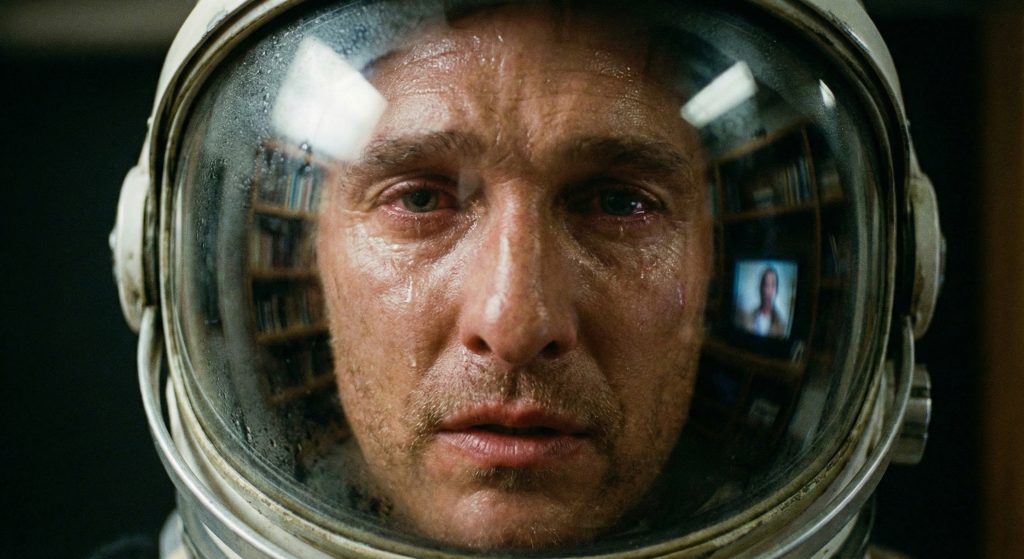
1. The “Ghost” Was Always Cooper
The biggest twist isn’t that aliens saved humanity; it’s that we saved humanity.
- The Tesseract: That infinite hallway of bookshelves isn’t magic. It’s a 3-dimensional representation of a 5-dimensional space, built by “They” (future humans) to allow Cooper to physically interact with time.
- The Gravity Morse Code: Cooper realizes that to save Earth, he has to send the quantum data from the black hole to his daughter, Murph. He does this by manipulating gravity across time—the “ghost” pushing the books and the dust.
2. Why “Love” Isn’t Just Cheesy Dialogue
Nolan gets hate for Anne Hathaway’s monologue about love, but in the context of the movie, it’s literal. The film argues that love is the only thing capable of transcending dimensions, acting like a navigational beacon. Cooper finds the exact moment in time to send the message because of his connection to Murph. It’s not magic; it’s the “variable” the robots couldn’t calculate.
3. The Final Scene: Where is He Going?
Cooper wakes up on Cooper Station (the cylindrical space colony). He is 124 years old (relotively), but physically the same. He reunites with an elderly Murph, who gives him closure. But where does he go at the end? He steals a ship to find Brand (Anne Hathaway). While everyone else is safe on the colony, Brand is alone on Edmunds’ Planet—the only habitable world they found. The final shot is Cooper heading out to be with her, completing the mission.
The Verdict
Cooper did not die. The “afterlife” theory debunks the entire point of the movie. Interstellar is a story about the endurance of human connection. The science is the vehicle, but the father-daughter bond is the fuel. He survived to keep his promise.

Jordan Blake is a rogue film critic and former VFX compositor with over 15 years of industry experience. Tired of paid reviews and “safe” opinions, Jordan left the studio system to tell the audience what Hollywood won’t. He specializes in forensic frame-by-frame analysis, exposing bad CGI, and decoding hidden lore that others miss.
Known for his “no-nonsense” approach, Jordan pays for his own tickets and refuses to attend press junkets, ensuring his loyalty belongs only to the fans. If a movie is a cash grab, he’ll say it. If it’s a masterpiece, he’ll explain why technically.
Specialty: VFX Breakdowns, Script Analysis, Hidden Details.
Motto: “Cinema doesn’t lie, but marketing does.”
Follow him for: The truth behind the pixels.