
Dan Trachtenberg’s bold 2025 entry forces you to root for the monster. That gamble pays off.
When the premise leaked a Predator film told entirely from the Predator’s point of view the skepticism was warranted. Franchises built around apex monsters rarely survive a full-perspective inversion. But Dan Trachtenberg, who quietly revived the series with Prey in 2022, has done it again. Predator: Badlands, the seventh installment in the franchise, opened in theaters on November 7, 2025, and is now streaming on both Disney+ and Hulu. It is the highest-grossing film in the franchise’s history, earning $184.3 million globally on an estimated $105 million budget.
The Dek Factor
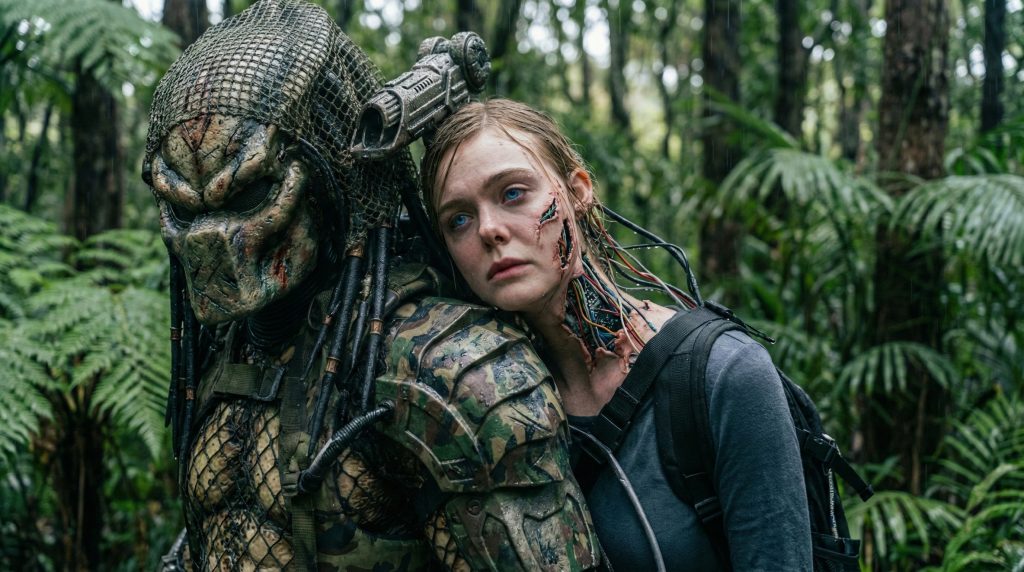
The film’s boldest decision was also its most necessary one: centering the story on Dek, a young Yautja cast out from his clan for being a runt. Dimitrius Schuster-Koloamatangi carries the role entirely through physical performance no English dialogue, no conventional emotional shorthand. He is hunting the planet Genna’s apex creature not merely to survive, but to earn back his place among the Yautja blooded.
Unlike the imposing hunters of John McTiernan’s 1987 original, Dek is lean, cornered, and desperate. When he rigs makeshift weapons from Genna’s alien flora, the scene deliberately echoes Dutch (Arnold Schwarzenegger) constructing jungle traps in the original film a poetic reversal that die-hard fans will catch immediately. To make us fear the monster, Trachtenberg first made us understand it.
Fanning’s Double Performance
Elle Fanning doesn’t play one character here she plays two. As Thia, a legless Weyland-Yutani synthetic who forms an unlikely alliance with Dek, she brings wit and warmth to a role that could easily have been purely functional. As Tessa Thia’s antagonist “sister” android she delivers a colder, more calculating counterweight. The dual performance, rarely spotlighted in the film’s marketing, is quietly one of the year’s more demanding acting feats.
The dynamic of Thia strapped to Dek’s back after losing the lower half of her body draws an inevitable comparison to C-3PO and Chewbacca in The Empire Strikes Back but with considerably more agency. A key midpoint scene, where Thia relays the biology and history of the Kalisk using only gesture and light signals, bridges Weyland-Yutani mythology from the Alien universe with the Yautja hunting code without a word of exposition. The comparison to Michael Fassbender’s android David in Prometheus holds up; this is one of the more layered synthetic performances the genre has seen in years.
The Kalisk: An Apex Creature Worth the Wait
The Kalisk formally catalogued as Specimen XX-0522 by Weyland-Yutani is the film’s most memorable creation. A colossal quadrupedal beast native to Genna, it is covered in chitinous black quills and possesses a regenerative biology that borders on unkillable: wounds seal in seconds, and a decapitated head reattaches before the fight resumes.
The final confrontation earns its runtime. In a detail that reframes everything, it is ultimately Tessa not Dek alone who destroys the Kalisk, freezing and shattering the creature in a sequence that makes the dual-Fanning casting feel retroactively inevitable. The visual effects team, working against footage shot across New Zealand’s Rotorua, Te Kūiti, and South Head Peninsula, produced creature work that holds up on paused frames. Real terrain, real light, real mud it shows.
What Trachtenberg Is Actually Building
Badlands is rated PG-13, a deliberate broadening of the audience that some franchise purists will resist. The box office suggests that resistance is a minority position. A closer look at Prey and Badlands together reveals a filmmaker constructing something more durable than a hit: a franchise repositioned around the moral weight of the hunt rather than its body count.
Trachtenberg keeps pulling the mythology deeper asking what honor costs in a species that defines itself entirely through violence. Whether another filmmaker could sustain that without him is the only real question left open. For now, the answer on screen is enough.
Jordan Blake is a rogue film critic and former VFX compositor with over 15 years of industry experience. Tired of paid reviews and “safe” opinions, Jordan left the studio system to tell the audience what Hollywood won’t. He specializes in forensic frame-by-frame analysis, exposing bad CGI, and decoding hidden lore that others miss.
Known for his “no-nonsense” approach, Jordan pays for his own tickets and refuses to attend press junkets, ensuring his loyalty belongs only to the fans. If a movie is a cash grab, he’ll say it. If it’s a masterpiece, he’ll explain why technically.
Specialty: VFX Breakdowns, Script Analysis, Hidden Details.
Motto: “Cinema doesn’t lie, but marketing does.”
Follow him for: The truth behind the pixels.